Regolith Habitats
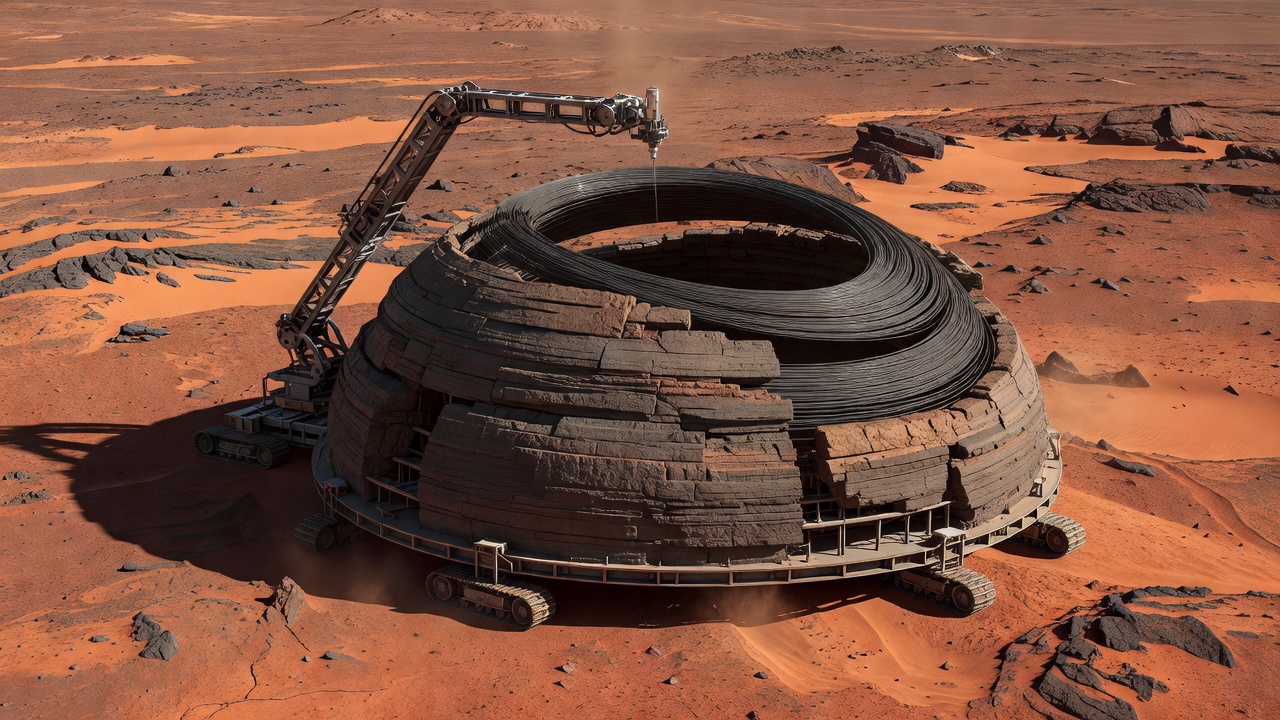
Without a thick magnetosphere or atmospheric blanket, Mars is bathed in solar cosmic rays and Galactic Cosmic Radiation (GCR). Engineering durable habitats requires additive manufacturing with basaltic aggregate to construct pressurized vaulted shelters.
Radiation Shielding Physics: Mass Attenuation
Cosmic radiation delivers an average surface dose of 240 to 300 millisieverts (mSv) per year on Mars—over thirty times the terrestrial background limit. Galactic cosmic rays consist of relativistic high-energy protons and atomic nuclei that produce lethal secondary neutron showers when striking heavy metallic hull walls like lead or aluminum.
In contrast, low-atomic-number materials like water, polyethylene, and silicate regolith absorb secondary neutrons without triggering severe cascading fragmentation. Layering 3 to 4 meters of unconsolidated and sintered regolith over inflatable Kevlar pressure vessels attenuates the annual radiation load below 20 mSv, safe within established international astronaut career exposure limits.
3D Additive Sintering with Autonomous Gantry Systems
Before crew arrival, robotic rovers equipped with microwave sintering horns and automated continuous-fiber extruders construct the base shelter shell:
- Site Excavation: Autonomous bulldozers clear boulders and level a basalt bedrock foundation.
- Core Deployment: An inflatable high-tensile vectran bladder deploys from the primary landing stage to establish internal volume.
- Additive Sintering: Robotic gantries apply layers of regolith mixed with sulfur or biopolymer binders, printing a catenary compression vault over the inflatable bladder.
- Thermal & Air Barrier: Spray-applied polyurethane sealants line the interior to preserve internal airlocks at 70 kPa (with 30% oxygen and 70% nitrogen).
| Shelter Concept | Radiation Cut | Pressurization Method | Structural Lifespan |
|---|---|---|---|
| Surface Sintered Dome | 82% Reduction | Internal Vectran Bladder | 15+ Earth Years |
| Lava Tube Cavern Base | 99.5% Reduction | Inflatable Modular Hubs | 50+ Earth Years |
| Buried Rigid Cylinder Module | 89% Reduction | Metallic Monocoque Shell | 10 Earth Years |
Lava Tube Outposts: The Natural Deep Underground Alternative
Volcanic structures in the Tharsis and Elysium regions harbor immense underground lava tubes. Many of these basaltic caverns measure over 100 meters across, easily accommodating entire self-contained residential villages, hydroponics arrays, and workshop bays completely immune to dust storms, micro-meteorites, and solar flares.