Subsurface Water Glaciers
Water is the vital lifeblood of planetary civilization. Beyond biological hydration, water is the indispensable chemical feedstock for the Sabatier propellant loop. Orbital radar shows sheet ice deposits stretching across mid-latitude plains under shallow dust blankets.
Targeting Mid-Latitude Glacial Reservoirs
Data returned from the Shallow Radar (SHARAD) sounder on the Mars Reconnaissance Orbiter confirms vast subterranean glaciers in Arcadia Planitia, Utopia Planitia, and Deuteronilus Mensae. These buried ice sheets often exceed 100 meters in thickness and are protected beneath 1 to 2.5 meters of dry lithic regolith.
Transporting water from Earth costs roughly $100,000 per liter in Delta-v mass penalty. Tapping local glacial formations provides virtually unlimited water for astronaut life support, radiation shielding reservoirs, and hydrogen fuel generation.
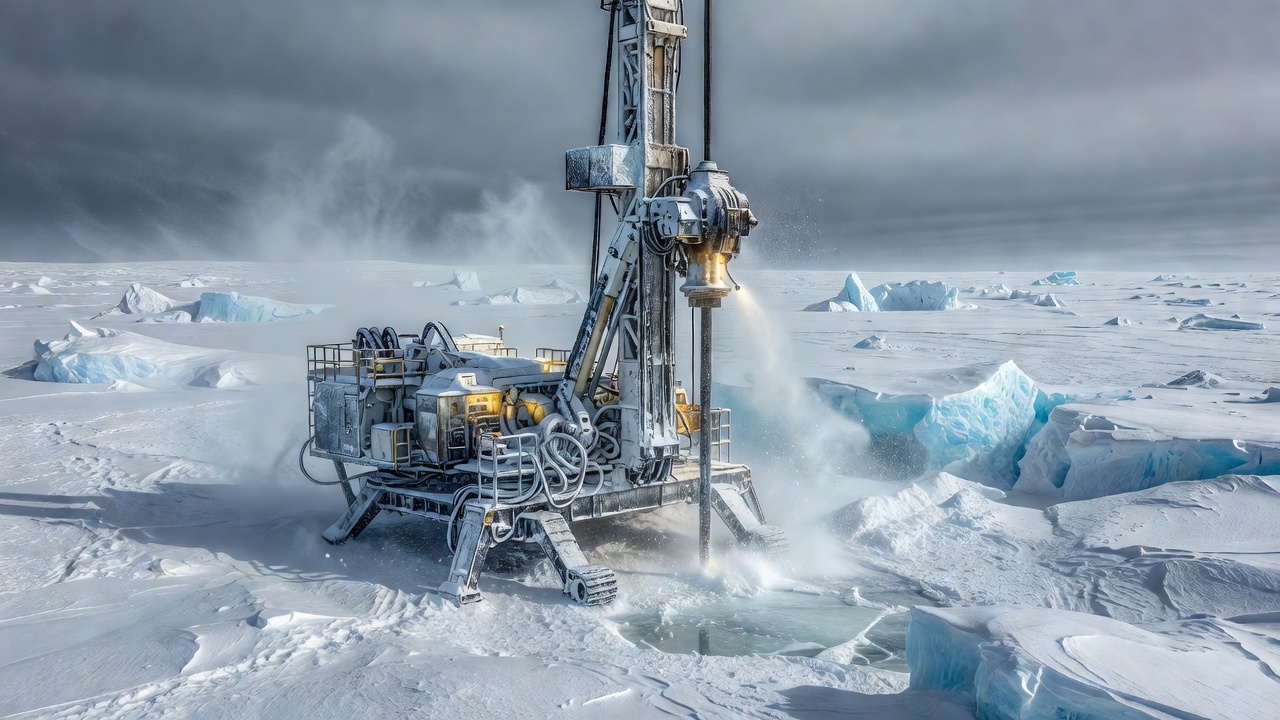
Rodriguez Well Thermal Extraction
Excavating rock-hard frozen cryogenic ice at -60°C with open front-loaders causes immediate sublimation into the near-vacuum air. Instead, expedition architects employ Rodriguez Wells (RodWells), a thermal extraction technique developed and proven at the Amundsen-Scott South Pole Station.
The operational protocol follows a disciplined 4-stage thermodynamic process:
- Overburden Penetration: A rotary mechanical core drill penetrates the dry perchlorate-laden surface lag deposit until pristine ice sheet contact is confirmed.
- Casing & Hermetic Sealing: An insulated telescoping casing seals against the borehole walls to prevent gas leakage into the thin 610 Pa atmosphere.
- Hot Water Circulation: Heated water (65°C) from a surface Kilopower thermal heat exchanger is pumped down the central drill pipe, creating a sub-surface pool of melted water.
- Cavity Expansion: A submersible pump continuously draws a fraction of the melted pool to surface storage while recirculating heat, maintaining an expanding spherical liquid subterranean reservoir.
| Site Candidate | Latitude | Overburden Depth | Estimated Ice Purity |
|---|---|---|---|
| Arcadia Planitia Base Alpha | 39.2° N | 1.2 – 2.0 m | 88% – 95% H2O |
| Erebus Montes Plateau | 35.8° N | 2.5 – 3.8 m | 78% – 84% H2O |
| Utopia Planitia Site Gamma | 46.7° N | 1.0 – 1.8 m | 92% – 97% H2O |
Purification and Salt Decontamination
Subsurface meltwater is naturally saturated with magnesium, sodium, and calcium perchlorates, along with heavy sulfate minerals. Before entering habitat drinking tanks or polymer electrolyte membrane (PEM) water electrolyzers, the raw liquor passes through:
- Mechanical crossflow microfiltration removing suspended silica particulates.
- Dual-pass reverse osmosis (RO) membrane arrays running at 65 bar pressure.
- Catalytic deoxygenation and ultraviolet sterilization beds.